

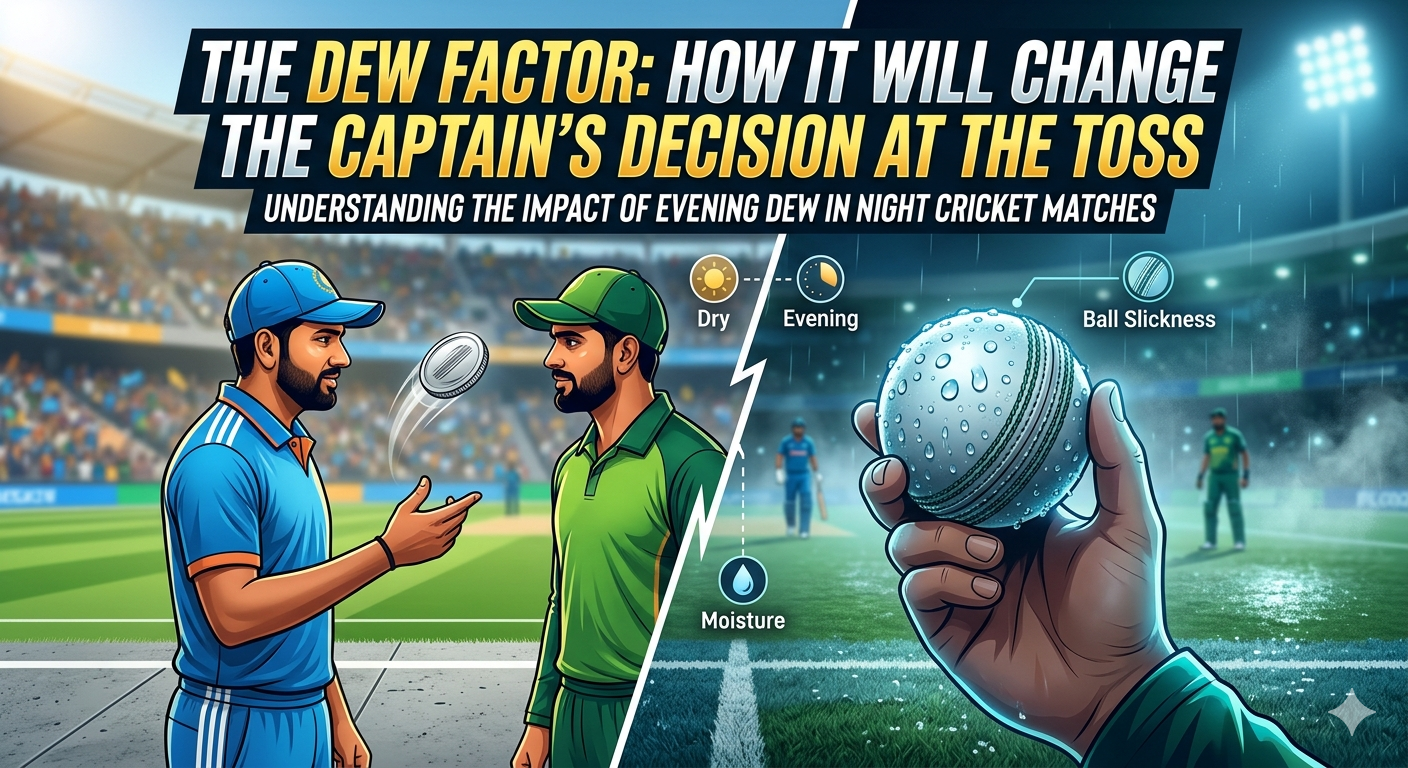
Have you ever wondered why a world-class captain, after winning the toss, looks at a clear sky and a flat pitch but decides to field first without a second thought? It isn't just a trend; it’s a desperate battle against a silent, invisible player that takes the field halfway through the game: The Dew.
In modern limited-overs cricket, especially in the Indian Subcontinent and Middle Eastern venues, the toss has transitioned from a 50-50 advantage to a "win toss, win match" phenomenon. The culprit is the dew factor—a game-changer that turns elite spinners into spectators and makes 200-run chases look like a walk in the park.
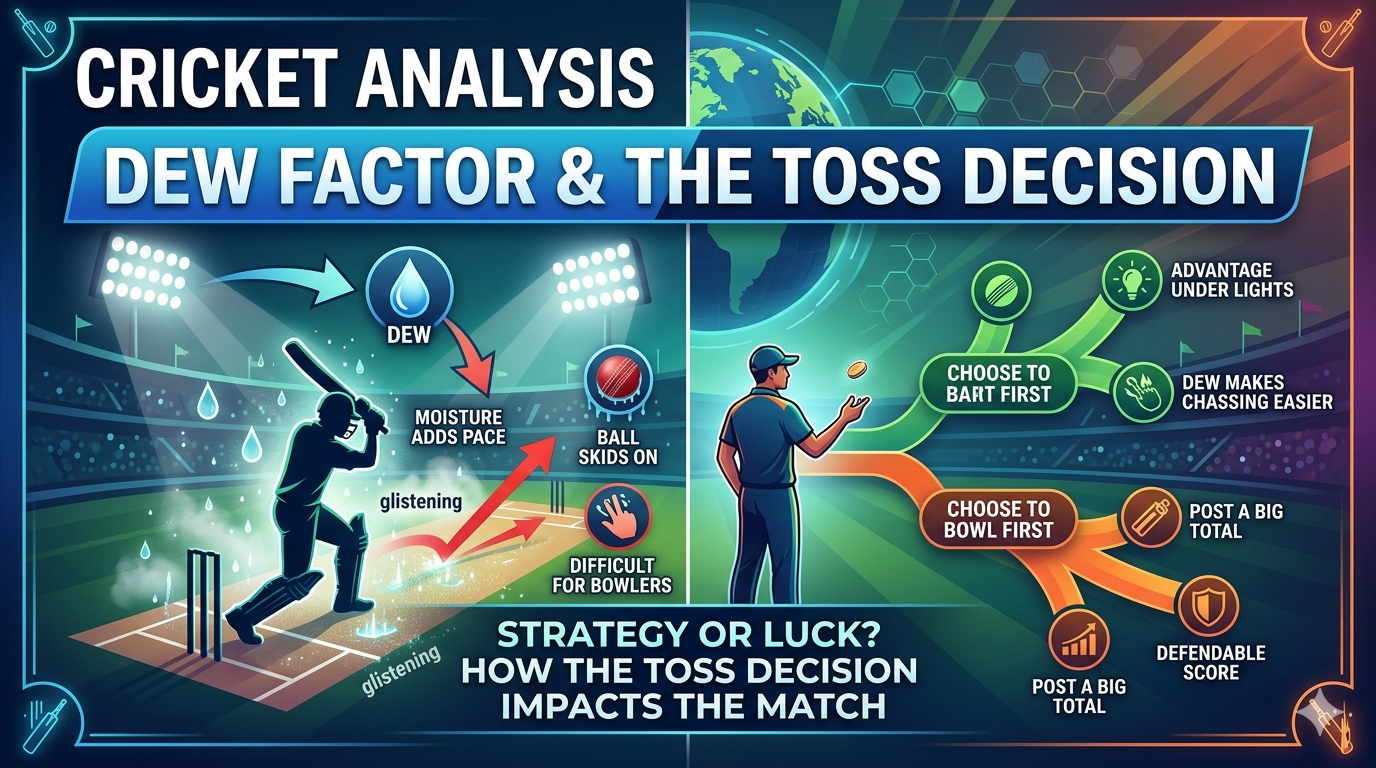
The Magnitude of the Moisture: Why Today Matters
Today’s high-stakes encounter isn't just about bat vs. ball; it’s about dry vs. wet. As the sun sets and the temperature drops, the atmospheric moisture condenses on the grass. For the team bowling second, this is a nightmare scenario.
When the ball becomes a "bar of soap," tactical plans go out the window. Today’s match context is crucial because the humidity levels are predicted to spike early in the second innings, making the toss the most critical event of the evening.
Key Highlights: The "Wet Ball" Summary
- The Grip Struggle: Spinners lose the ability to "purchase" turn from the pitch as the seam becomes slippery.
- The Skid Factor: A wet ball doesn't grip the surface; it skids on faster, making it easier for batters to time their shots.
- The Outfield Speed: Dew-slicked grass acts like a slide, accelerating the ball to the boundary and making life miserable for fielders.
- The Statistical Edge: Teams chasing under heavy dew have a 65-70% higher win probability in night matches at specific venues like Wankhede or Dubai.
- The Tactical Shift: Captains are now picking extra pace options over spinners if they anticipate heavy dew.
Deep Analysis: The Science Behind the "Slippery Slope"
1. The Death of Finger Spin
In dry conditions, a spinner uses the friction between their fingers and the leather seam to impart revolutions. Under the dew factor, that friction disappears. We’ve seen legends of the game struggle to land the ball in the right areas, often resulting in high full tosses or "drag-downs" that get punished.
2. The Batter’s Paradise
When the ball is wet, it stays harder for longer but loses its swing. For a top-order batter, this is the ultimate "hit-me" scenario. The ball skids onto the bat, meaning they don't have to power the shot; they simply use the bowler’s pace. This is why we see massive scores being chased down with overs to spare in the second half of the game.
3. The Bowler’s Psychological Burden
It isn't just physical. Knowing that you cannot execute a yorker because the ball might slip out of your hand creates a defensive mindset. Bowlers often resort to "safe" lengths, which elite batters easily exploit.
Key Factors That Will Decide Today's Outcome
The Humidity Index
Weather stations are predicting a humidity jump from 45% to 82% between 7:00 PM and 9:00 PM. This narrow window is where the game will be won or lost. If the "dew point" is reached early, the team batting first is effectively out of the contest unless they post a "dew-proof" total (usually 20-30 runs above par).
The Groundstaff’s "Rope Trick"
Watch the mid-innings break closely. You will see groundstaff dragging a heavy rope across the grass. This is a manual attempt to clear the moisture. While it helps for a few overs, the dew usually returns within 15 minutes, making it a temporary fix for a permanent problem.
The Use of Chemicals
Many venues now use anti-dew sprays (like ASPA) on the outfield. These chemicals create a hydrophobic layer on the grass to prevent water beads from forming. However, their effectiveness varies based on the volume of dew.
Expert Prediction: What to Expect at the Toss
Scenario A: If Team A wins the toss... They will bowl first without hesitation. Their strategy will be to restrict the opposition to under 180 and then capitalize on the wet ball in the second innings to chase it down by the 18th over.
Scenario B: If Team B is forced to bat first... Expect an ultra-aggressive start. They know that 170 isn't enough. They will likely aim for 210+, taking higher risks in the Powerplay to create a "cushion" for their bowlers who will struggle with the wet ball later.
The Verdict: The team chasing holds a 75% advantage tonight. The toss isn't just a formality; it’s a massive tactical headstart.
Stats, Records & Trends: The "Dew" Effect in Numbers
Venue | Matches Won Batting First | Matches Won Batting Second | Average Win Margin (Chasing) |
|---|---|---|---|
Wankhede Stadium | 38% | 62% | 7 wickets |
Dubai Int. Stadium | 32% | 68% | 8 wickets |
Chinnaswamy | 42% | 58% | 6 wickets |
Historical Insight: During the 2021 T20 World Cup, the toss became so influential that 12 out of 13 night matches in Dubai were won by the team batting second.
Fan Reactions & Trending Buzz
Social media is already abuzz with the hashtag #TossWorldCup. Fans are debating whether the "Dew Factor" is ruining the fairness of the game.
- @CricketGuru: "Winning the toss shouldn't be 80% of the result. We need better solutions than just towels and ropes!"
- @StatmanX: "The dew tonight in Mumbai is going to be 'soup-level.' Batters are going to feast."
The Final Verdict
In the battle of man vs. nature, nature often wins. The Dew Factor is the ultimate disruptor in modern cricket. While teams are getting better at practicing with wet balls, the tactical advantage of chasing under the lights remains undisputed.
If you're betting on tonight's game or just watching for the thrill, keep your eyes on the 7:00 PM toss. That small silver coin might just decide the winner before a single ball is even bowled.
What do you think? Should ICC change the timings of matches to avoid the dew, or is it just another part of the game’s unique challenge? Let us know in the comments!
People Also Ask
Q1: Who will win today’s match?
While both teams are balanced, the team that wins the toss and chooses to bowl second will have a significant psychological and technical advantage due to the dew.
Q2: Where to watch the match live?
You can stream the match live on the official sports broadcaster’s app (Hotstar/JioCinema) or watch it on the Star Sports/Sports18 network on TV.
Q3: What time does the match start?
The toss takes place at 7:00 PM IST, and the first ball will be bowled at 7:30 PM IST.
Q4: Is the match available online for free?
Depending on your region, some platforms offer free streaming for mobile users via specific telecom partnerships. Check your local provider for details.
Q5: What exactly is the 'Dew Factor' in cricket?
It refers to the moisture that settles on the grass at night. It makes the ball wet, making it hard for bowlers to grip and easier for batters to hit.
Q6: Why is the toss so important in night matches?
Because the team batting second benefits from the dew, as the bowlers of the first team struggle to control a slippery ball.
Q7: Can bowlers use sand to dry the ball?
No, using external substances like sand or dirt is generally against the rules. Bowlers usually use a towel provided by the umpire.
Q8: Does dew affect pace bowlers too?
Yes. While it affects spinners' turn, it prevents pace bowlers from bowling accurate yorkers or slower balls, as the ball slips from their hand.
Q9: Which stadiums have the most dew?
Coastal stadiums like Wankhede (Mumbai), Eden Gardens (Kolkata), and desert venues like Dubai and Abu Dhabi see the most dew.
Q10: What is a 'Dew-Proof' total?
It is a score (usually 200+) that is high enough that even with the disadvantage of a wet ball, the bowling team has enough runs to defend.
Q11: Do captains ever bat first in dew conditions?
Rarely. Only if the pitch is expected to crumble or slow down significantly in the second innings, but this is a high-risk gamble.
Q12: How do teams prepare for dew?
Teams often practice with "wet balls" in the nets, dipping cricket balls in buckets of water before bowling to simulate match conditions.
Q13: Is the dew factor fair?
Many experts believe it introduces too much "luck" into the game, but it remains a natural part of the outdoor playing environment.
Q14: What is the 'Anti-Dew' spray?
It is a chemical spray applied to the outfield grass to reduce the formation of moisture beads.
Q15: Does the dew factor happen in Test cricket?
Rarely, as Test matches are mostly played during the day. However, Day-Night Tests with the pink ball are heavily influenced by it.