

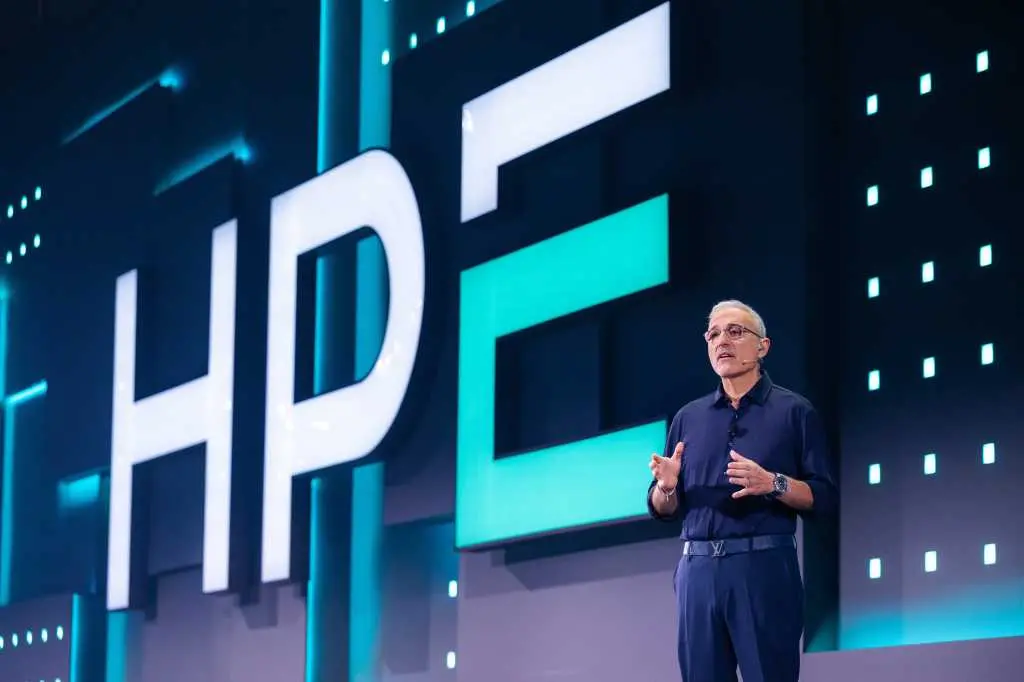
Hewlett Packard Enterprise (HPE) is making an aggressive bet on artificial intelligence, with CEO Antonio Neri using the company's HPE Discover 2026 conference in Las Vegas to detail a sweeping architectural overhaul built specifically for the age of AI agents. The keynote, delivered to thousands of attendees, outlined how HPE is rethinking every layer of the data center stack—networking, compute, storage, and operations—to handle workloads that are now being driven by both human users and autonomous software agents.
"Today, we are witnessing one of the largest technology platform shifts in history," Neri said. "Workloads and applications are moving from being driven by end users [to] now being driven by both end users and AI agents." This shift, he argued, demands a fundamentally different approach to infrastructure, one where the network is no longer a passive transport layer but an active participant in AI workload orchestration.
The network as the AI foundation
Neri's keynote placed networking at the center of the AI transformation. "Every byte, every token, every decision, all of it crosses the network," he emphasized. HPE has been integrating Juniper Networks following its $14 billion acquisition, and the new product lineup reflects that deep integration. The company introduced the QFX series of switches for scale-up within GPU racks and scale-out across clusters, the PTX 12,000 routing platform for data center interconnect with 800G capacity, the SRX 4700 quantum-safe firewall capable of 1.44 Tbps throughput in a single rack unit, and the MX 301 edge router built on Juniper's sixth-generation Trio silicon. All these are designed to reduce latency, a critical factor in AI training where milliseconds matter. Neri illustrated the cost of delay: "Multiply[ing] a small delay across hundreds of thousands of GPUs over weeks of training in your network can mean the difference between training a new model in 90 days or 30 days. It is the difference between chasing a breakthrough or making one." Additionally, HPE extended Marvis Actions, the AI-driven network operations engine, to Aruba Central and Aruba CX switching via the HPE Mist platform, enabling proactive issue resolution.
Compute optimized for agentic AI
On the compute side, HPE organized its portfolio into three AI Factory tiers targeting enterprise, service provider, and sovereign deployments. The highlight is the new ProLiant DL 394 Gen 12, purpose-built for agentic AI and long-context workloads. Neri claimed that at the AI Factory at Scale tier, new configurations deliver training with one-quarter the GPUs of the previous Blackwell-generation platform and inference at one-tenth the cost per million tokens. Private Cloud AI now scales to 256 GPUs with multi-node inference, complemented by a unified gateway providing a single API for both frontier and open-source models. A shared cache reduces the cost per first token, making large-scale deployment more economical. "Private cloud AI can now serve larger models across multiple systems with multi node inference, so capacity grows with the math," Neri noted.
Unified storage for AI data pipelines
Agents are only as capable as the data behind them, which is why HPE retooled its storage architecture. The Alletra MPX 10,000 now serves as the storage layer for Private Cloud AI, unifying file and object storage on a single architecture. It adds real-time metadata enrichment and native MCP (Memory-Centric Platform) support, enabling agents to retrieve data across structured and unstructured sources seamlessly. The solution achieves Nvidia Certified Storage validation and delivers 7 to 12 times faster time to value compared to custom-built environments, according to HPE. "Your AI agents are only as smart as the data you use to train them," Neri said. "Traditionally, that data required custom preparation for every use case and months of building the right AI data pipelines, but not anymore."
Governance and operations for agentic enterprises
As AI agents proliferate across enterprises—often deployed outside formal IT oversight—HPE introduced a governed agent layer within Private Cloud AI. Enterprises can register agents built in any framework, applying security controls on API calls, identity, and encryption with zero code changes. A three-tier identity model verifies the user, governs the agent, and requires human approval for sensitive actions. The platform integrates Nvidia Open Shell for isolated, policy-enforced agent runtimes, NeMo Cloud for governed workflow blueprints, and Zerto for clean-state rollback when agents make errors. Additionally, HPE CloudOps consolidates virtualization, data protection, and cloud management into a single hybrid operating layer. The Unleash AI program now covers more than 60 validated partners, broadening the ecosystem.
Neri also addressed a critical constraint facing the industry: power. "Every model, every workload, every agent depends on power, because at its core, an AI factory is doing one thing: turning electrons into tokens," he said. He noted that the U.S. faces a 19-gigawatt power gap by 2028, with data centers projected to account for nearly half of U.S. electricity demand through 2031. "As AI scales, the future will not be defined by compute alone. It will be defined by how efficiently we can power it, cool it, and connect it." This emphasis on power efficiency ties back to the networking and compute optimizations announced throughout the keynote, underscoring HPE's holistic approach to AI infrastructure.
Source: Network World News