

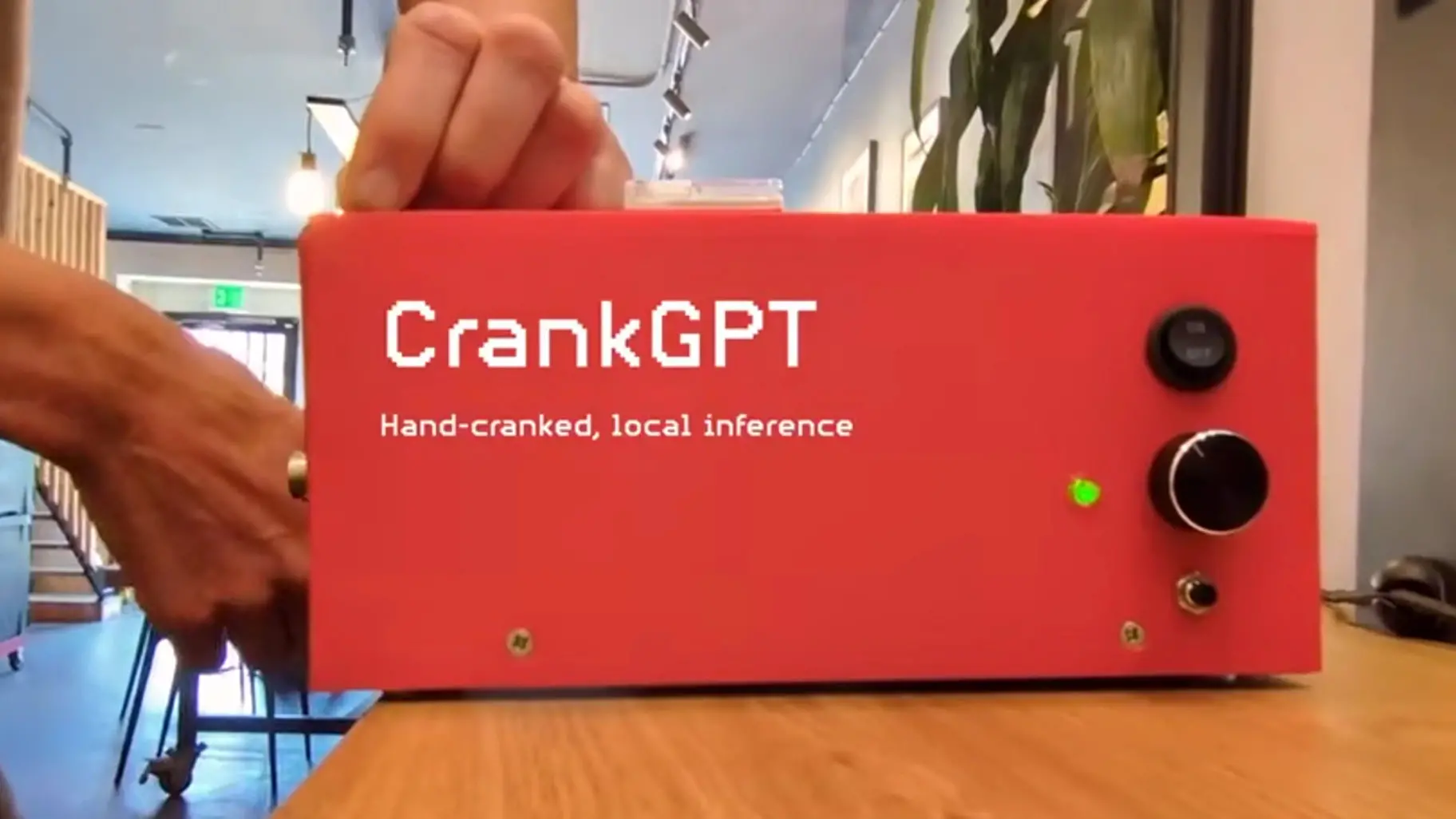
A Europe-based company called Squeez Labs has introduced a new AI chatbot concept that challenges the resource-intensive nature of modern generative AI tools. Named CrankGPT, this device is a tiny box that runs entirely on a hand crank, with no battery or external power source. It uses a 20W hand-crank generator, a stock Raspberry Pi 5 with 8GB of RAM, and local language models to process speech and generate responses. The idea is to offer a private, cost-effective, and environmentally friendly alternative to cloud-based chatbots like ChatGPT or Google Gemini.
How CrankGPT Works
The CrankGPT box houses a hand-crank mechanism that directly powers the Raspberry Pi 5 and its peripherals. Users turn the crank to generate electricity, which then feeds the hardware. The system uses the Piper voice model for speech recognition and synthesis, and it can run small language models such as Liquid AI LFM2 (350M or 1.2B variants) or Gemma (1B). These models are small enough to operate efficiently with the limited power from the crank. According to the creators, the device can handle everyday queries like simple questions, poetry, or basic code generation, though it struggles with heavy tasks like image generation.
One notable aspect is the noise generated by the crank, which the developers acknowledge as a trade-off for privacy and energy efficiency. They have also integrated a cooling fan to manage heat during extended use. The device gets harder to turn when speech synthesis and LLM inference happen simultaneously, as the power demand spikes.
Why Hand-Crank AI?
The motivation behind CrankGPT stems from what Squeez Labs describes as a European sensibility for practical, small-scale solutions. They were struck by the wastefulness of running massive AI models for trivial tasks, consuming kilowatts of energy and thousands of tokens. The creators argue that small models can accomplish many tasks just as well as huge ones, but with a fraction of the cost and energy. By making the user physically exert effort to power the device, it forces a more mindful approach to AI usage.
Furthermore, the device is fully local and private. All processing happens on the Raspberry Pi, and no data leaves the box. This addresses privacy concerns associated with cloud-based AI services, where user data is often sent to remote servers.
Technical Details and Design
The core of CrankGPT is a 20W hand-crank generator, which is a robust unit capable of converting human power into electrical energy. This feeds the Raspberry Pi 5, which has taken the place of its predecessor as a compact and versatile single-board computer. The software stack includes a custom interface that listens for voice input, processes it through a local LLM, and then outputs audio via the Piper model. The creators have optimized the system to minimize power consumption, ensuring that even moderate hand-cranking can sustain continuous operation.
In tests, the device can generate responses to simple questions in a reasonable time, though it is not as fast as cloud-based chatbots. The noise level is comparable to a small generator, which may be distracting in quiet environments. However, for a device that is intended to be used in short bursts, this is acceptable.
Environmental and Economic Implications
AI chatbots currently rely on massive data centers that consume enormous amounts of electricity and require rare earth minerals for hardware. Training large models like GPT-4 or Gemini has a significant carbon footprint. Hand-cranked devices like CrankGPT eliminate the need for constant energy draw, as the user provides the power. This makes it a potential solution for off-grid use or for reducing personal AI footprint.
However, the creators note that training the AI models themselves still involves substantial computational resources. Until that portion of the AI lifecycle is addressed, the overall environmental benefit of hand-cranked chatbots remains partial. Still, the concept highlights that not every AI interaction requires a massive server farm.
Historical Context of Hand-Crank Technology
Hand-crank generators have been used for decades in rural radios, emergency flashlights, and military equipment. They provide a reliable way to generate electricity without batteries or solar panels. Integrating this with modern computing is a natural progression. For example, during the cold war, farmers used hand-crank radios to stay informed. Today, the challenge is to provide enough power for modern processors while keeping the crank effort manageable. The Raspberry Pi 5 is particularly power-efficient, drawing around 5-10W during normal operation, which the 20W generator can handle.
There are also educational implications. Schools could use CrankGPT to teach students about energy conversion, AI, and sustainability. The device serves as a tangible demonstration of the power required to run digital assistants.
Current Status and Future Prospects
Squeez Labs is currently accepting requests for demonstrations of CrankGPT, but no wide release or pricing has been announced. The company may decide to manufacture units if there is sufficient interest, or it might remain a concept to inspire larger changes in the AI industry. The idea could be adapted for other applications, such as encrypted messaging or offline navigation.
Nevertheless, CrankGPT underscores an important point: as artificial intelligence becomes more integrated into daily life, the energy and resource demands must be critically examined. While this hand-cranked box may not replace ChatGPT, it offers a blueprint for more sustainable, user-controlled AI systems. The creators hope that it will spark conversations about efficiency and mindset, reminding people that not every query requires a supercomputer.
As AI continues to evolve, solutions like CrankGPT could lead to a broader adoption of small, local models that are both private and less harmful to the environment. However, training these models remains a challenge that the industry must address to fully achieve sustainability goals.
Source: Android Authority News