

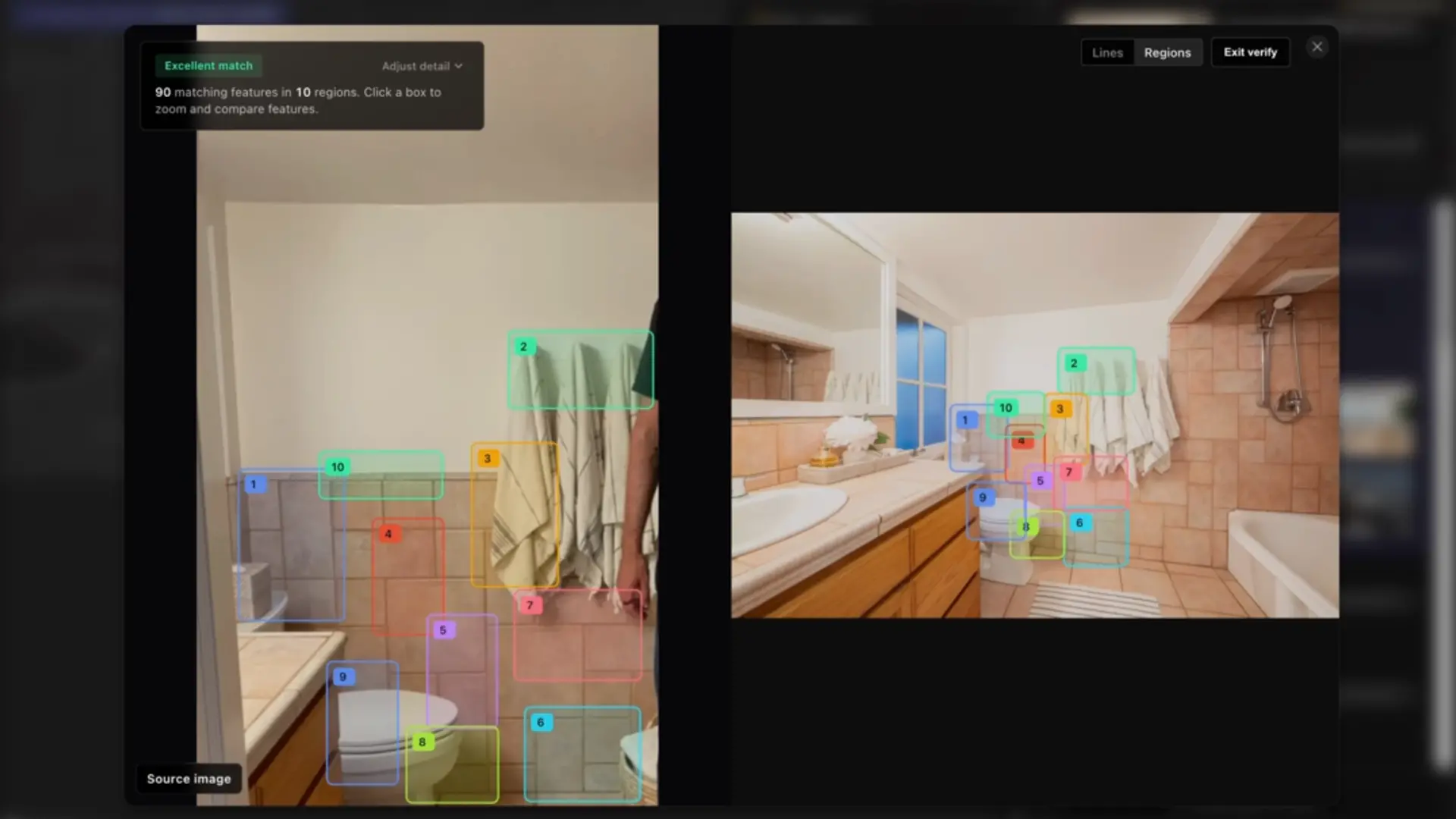
A newly demonstrated artificial intelligence tool can examine ordinary photographs taken inside a home and estimate where that home is located, according to a new report on the technology. The system does not rely on hidden GPS data or obvious landmarks. Instead, it studies visual details that most people ignore: the shape of a window, the style of a radiator, the pattern of floorboards, the view through a pane of glass, the placement of electrical outlets, and the mix of furniture and building materials. Individually, those clues may seem trivial. Combined by a machine-learning model, they can become a fingerprint that points to a neighborhood, a city, or even a specific building.
The tool’s arrival is the latest sign that advanced image analysis is moving from the laboratory into everyday privacy debates. For years, researchers and open-source investigators have used photo metadata, landmarks, street signs, and social media context to work out where images were taken. The new generation of AI systems is different because it can draw inferences from the contents of a picture itself, including scenes that were never meant to reveal a location. A photo of a kitchen, a bedroom, or a living room can now be treated as a source of geographic evidence.
Key facts
- A new AI tool can analyze ordinary household photos and infer likely geographic locations from visual clues rather than metadata.
- The system uses details such as window styles, radiators, outlets, flooring, furniture, building materials, and views through windows.
- The ability could help investigators, but it also raises serious risks for stalking, burglary, domestic abuse, and mass surveillance.
- Privacy advocates say law enforcement use should require warrants, transparency, accuracy testing, and clear limits.
- Experts recommend stripping location metadata, limiting interior images online, blurring windows, and adopting stronger legal safeguards.
How the technology works
Image geolocation is not new. Early efforts depended heavily on metadata embedded in digital photos, such as GPS coordinates or camera settings. When that information is missing, investigators have long relied on manual open-source research: matching skyline features, identifying road signs, comparing architecture, or checking the angle of shadows. The process is slow, requires expertise, and often depends on a lucky break. AI changes the economics of that work by automating pattern recognition at scale.
The new tool appears to combine several machine-learning techniques. One component may identify architectural and interior-design features associated with particular regions or construction periods. Another may compare window views against street-level imagery or map data. A third may learn statistical relationships between objects, materials, and geography. The model can then assign probabilities to possible locations. Even when it cannot name a precise address, it may narrow a search to a city, a suburb, or a housing development, giving investigators or other users a starting point for further research.
What makes indoor geolocation especially sensitive is that homes are supposed to be private. People post images of their living rooms, kitchens, and bedrooms on social media, rental listings, marketplace ads, and dating profiles. They may not realize that a photograph of a child’s bedroom or a home office can contain identifying details. A window view might reveal a distinctive building. A radiator might indicate a country. A wall socket might narrow the region. Packaging in the background might show a language or a product line. The AI does not need one perfect clue; it can aggregate many weak signals.
Why law enforcement is interested
The technology arrives as police agencies around the world are experimenting with AI-assisted investigations. Departments already use facial recognition, license-plate readers, drone imagery, cell-site analysis, and open-source intelligence. An indoor geolocation tool could be attractive in cases involving missing persons, human trafficking, child exploitation, fraud, or violent crime. If investigators have a photograph of a room and no metadata, an AI system might help them generate leads faster than manual research.
That potential is real, but so is the risk of overreach. Law enforcement access to location information is tightly regulated in many jurisdictions, yet AI inference tools can fall into a gray zone. If an agency uploads a photo to a commercial service or uses a model trained on scraped images, the legal basis for that use may be unclear. Civil liberties groups worry that the technology could become a backdoor to location surveillance, especially if it is used without a warrant or applied to large collections of images. They also warn that errors could send investigators down the wrong path, wasting resources and damaging innocent people’s lives.
Privacy advocates are particularly concerned about domestic abuse, stalking, and burglary. A person who posts a photo of a new apartment may inadvertently reveal its location to an abusive former partner or a criminal who is looking for empty homes. Real estate agents, landlords, and online sellers could expose property details at scale. Even a seemingly harmless picture of a pet by a window can carry clues about the building, the street, or the neighborhood. When such images are combined with social media profiles, public records, and other data, the result can be a detailed picture of a person’s daily life.
The accuracy problem
AI geolocation systems are not infallible. They can confuse similar architectural styles, misinterpret reflections, or overfit to patterns in their training data. A model trained mostly on images from one country may perform poorly elsewhere. A photo taken in a renovated apartment may lack the historical features the model expects. A view through a window may be too blurry to use. These limitations matter because a confident-sounding prediction can be wrong. In a criminal investigation, a false lead is not just a technical error; it can lead to surveillance, interrogation, or public suspicion.
Accuracy also depends on how the tool is used. A system that offers a ranked list of possible neighborhoods is different from one that claims to identify a specific address. The former may be a useful investigative aid; the latter could be treated as evidence. Without independent testing, disclosure of error rates, and human review, it is difficult for courts, regulators, or the public to know which is which. Experts say any deployment should include clear documentation of the model’s limitations and a requirement that investigators corroborate its findings through traditional methods.
Privacy and legal gaps
The legal landscape has not caught up with the technology. In the United States, the Fourth Amendment protects against unreasonable searches and seizures, and the home receives special protection. But courts have not settled how existing rules apply to AI that infers location from images rather than collecting coordinates directly. In Europe, data protection law gives people rights over their personal data, but enforcement can be slow and uneven. Elsewhere, agencies may operate with few explicit constraints. The result is a patchwork of rules that varies by country, state, and even police department.
There is also the question of commercial use. Companies that offer image analysis services may collect uploaded photos, retain them, or use them to improve their models. Users may not know that an image submitted for a seemingly simple task is being repurposed for geolocation research. Data brokers could combine such inferences with other records. Insurers, marketers, and landlords might find location clues valuable. The privacy risk is not limited to government surveillance; it extends to any organization with access to images and the computing power to analyze them.
Safeguards and practical defenses
Privacy experts recommend several layers of protection. At the individual level, people can remove location metadata before posting photos, avoid showing windows or distinctive interiors, blur identifying details, and limit the audience for images of their homes. They can also review privacy settings on social media and ask landlords or real estate platforms how property photos are used. These steps are not foolproof, but they raise the cost of casual inference.
At the institutional level, the safeguards need to be stronger. Law enforcement agencies should require warrants or equivalent legal process before using AI geolocation tools in investigations, especially when the target is a home. They should disclose the use of such tools in court, keep audit trails, and submit models to independent accuracy testing. Companies should be transparent about whether they retain uploaded images and should not train location-inference models on user photos without clear consent. Regulators should consider rules that limit bulk geolocation and require impact assessments before deployment.
Researchers also have a role. They can publish error rates, test models across regions, and examine how easily the technology can be repurposed for harassment or burglary. Journalists and civil society groups can document cases where location inference causes harm. Transparency is not a complete solution, but it makes hidden capabilities visible. The public cannot debate a tool it does not know exists.
Unresolved questions
The underlying trend is clear: AI is making it easier to extract information from images that people once considered ordinary. Indoor photos are especially revealing because homes are filled with personal choices and structural details. A single image may not give away an address, but a collection of images, combined with other data, can be powerful. As the technology improves, the gap between what people expect to reveal and what a machine can infer is likely to grow.
That does not mean the tool should be banned outright. Geolocation from images can help find missing people, identify disaster damage, or verify human rights abuses. The question is how to capture those benefits without creating a new layer of surveillance around the home. The answer will depend on law, design, and social norms. It will also depend on whether the companies and agencies that build and use these systems are willing to accept limits before a high-profile harm forces them to.
The central question is not whether the technology works, but who gets to use it, under what rules, and with what recourse for people whose homes are identified without consent.
Source: TechRadar News