

Generative AI image tools have moved from novelty to serious production software in just a few years. A new nine-prompt evaluation of six paid AI image generators has found that the market now has a clear leader: Google's Nano Banana Pro, part of Gemini 3. The model earned a near-perfect score of 93%, finishing far ahead of ChatGPT's image generator at 74%. Midjourney, Adobe Firefly, Leonardo AI and Canva followed with scores between 43% and 57%.
The test was designed to reflect real-world tasks rather than simple one-off prompts. It covered four broad categories: revising existing images, generating original images, adding text to images, and leveraging pop culture. All images were generated in a 1:1 square ratio so results could be compared side by side. The same nine prompts were fed to every tool.
Key facts at a glance
- Google's Nano Banana Pro, part of Gemini 3, scored 93% and ranked first.
- ChatGPT's image generator scored 74% and ranked second.
- Midjourney scored 57%, Adobe Firefly 54%, Leonardo AI 52%, and Canva 43%.
- The test used nine prompts across photo recontextualization, restoration, original generation, text rendering, and pop-culture scenes.
- Pricing ranged from $9.99 per month for Adobe Firefly Standard to $20 per month for ChatGPT Plus and Canva Business.
- Nano Banana Pro produced accurate text and detailed pop-culture references, but it added a watermark and had one session mix-up.
- ChatGPT showed strong natural-language iteration but struggled with some pop-culture prompts.
- Midjourney excelled at cinematic and fantasy imagery but often omitted text and struggled with cleanup.
- Adobe Firefly was cautious about copyright and refused some prompts.
- Canva and Leonardo produced usable logos but had significant errors in photo restoration and text.
How the evaluation worked
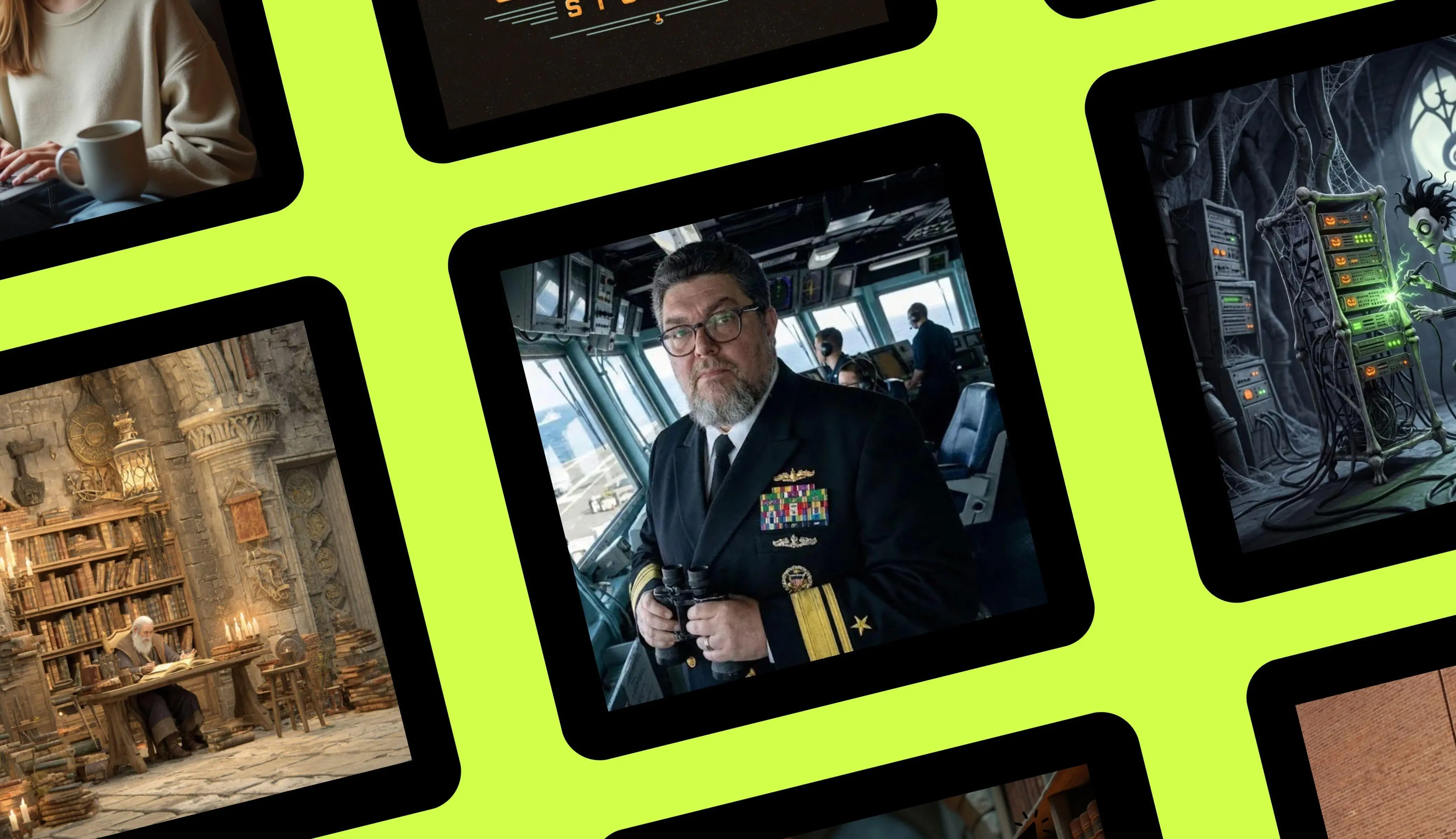
The test suite was built around practical tasks. For photo recontextualization, the same portrait was submitted with a request to dress the subject in a US Navy admiral's uniform on the bridge of an aircraft carrier while preserving the face. For restoration, old black-and-white photographs were submitted with prompts asking for scratch removal, clarity improvements, and natural colorization. For original generation, the tools were asked to create a retro-futuristic logo for a video studio called Space Coast Studios, a fantasy scene of a medieval librarian in a candlelit stone library, a studio portrait of a senior adult holding a flagship smartphone, and a candid portrait of a student using a MacBook Pro near a cup of coffee.
Text rendering was a major part of the test. Two social-media-style images required specific ad copy to appear on the image: 'Simple. Powerful. Made for everyday life.' and 'Moments that matter, always within reach.' The pop-culture prompts asked for a poster for a fictional fourth Back to the Future movie set in 1920s New York and a Nightmare Before Christmas-style IT professional in a data center. Points were awarded for accuracy, realism, text correctness, preservation of original facial features, and adherence to the prompt. Points were deducted for errors, omissions, unwanted changes, or refusals.
Google Gemini 3 Nano Banana Pro: 93%
Nano Banana Pro was the standout. It earned 93%, a near-perfect result that the evaluation described as a no-contest knockout. The model is available as part of Google AI Pro for $19.99 per month. It handled nearly every category with unusual precision.
In the admiral recontextualization test, it kept the subject's face and glasses while changing the angle of the face, placing the subject properly on a ship's bridge and adding binoculars. It also preserved the original subject's identity in a restoration of a childhood photo, brightening an image that had been too dark to see clearly. The model's text rendering was strong in the logo test, where it picked up themes such as a palm tree, rocket, film, and readable lettering. In social-media images, the text fit cleanly over the image without errors.
The pop-culture results were especially notable. For the fictional Back to the Future poster, Nano Banana Pro produced a recognizable DeLorean and skateboard, used a logo style that evoked the film franchise, placed 'New York City 1925' on a marquee, and added the tagline 'The Roaring Twenties Got Heavy.' It also put the Marty McFly character into period clothing. The Nightmare Before Christmas-style data center image also captured the requested Tim Burton feel.
The model was not flawless. It put a watermark in the bottom corner of each image, which is annoying for professional use. In one case, it returned the wrong image twice before producing the requested truck cleanup. When it did clean up the truck, the lettering was mostly accurate but misread 'RADIOLOGICAL DEFENSE' as 'BADICLOGICAL DEFEKSE.' Those issues cost a few points, but not enough to threaten its lead.
ChatGPT: 74%
ChatGPT's image generator finished second at 74% and costs $20 per month as part of ChatGPT Plus. The evaluation noted that OpenAI's image tool is now described as 'GPT-4o image generation in ChatGPT,' and that a newer ChatGPT Images update was used for the final ratings. The update improved some results but created new inconsistencies.
ChatGPT performed well on natural-language iteration. In the admiral test, the face looked like the original subject, though the uniform's rank insignia were unclear and seemed to mix a lieutenant and an O-8 admiral. The childhood photo restoration kept the original face rather than swapping in a random adult's face, which was an improvement over an earlier version. The truck cleanup changed 'RADIOLOGICAL DEFENSE' to 'RADIO CHEMICAL DEFENSE' and added an extra space, costing points but not as many as the previous version.
The logo and librarian images were acceptable, and the social-media posts used correct text, though both blocks of text were placed in the same position. Lighter font styles and poor contrast made the text harder to read, which cost a point each. The biggest problem came with pop-culture prompts. A Back to the Future-inspired request and a Nightmare Before Christmas-inspired request produced poor results, dropping the new model's score from 81% for the previous version to 74%. The evaluation concluded that pop-culture references in ChatGPT are hit or miss: a user might get a strong genre image or a refusal.
Midjourney: 57%
Midjourney scored 57% and costs $10 per month for the Basic plan. It remains a strong choice for hyper-creative, cinematic imagery. The librarian image was almost exactly what the prompt described, and the Nightmare Before Christmas-style IT professional was one of the favorite outputs in the entire test. When Midjourney works, it produces visually distinctive results that stand out from more literal models.
But the tool struggled with cleanup, recontextualization, and text. In the admiral test, it reproduced a yellow shirt and some background elements but did not preserve the subject's identity. A ship appeared in the background for no clear reason. The childhood photo was not cleaned up and was arguably made worse. The truck image was replaced with a different truck, and a woman resembling a Star Trek captain was inserted into the scene. All three images were delivered in a 1:1 format, but they were simply placed on a 1024x1024 canvas.
Midjourney's logo included correct text, a palm tree, and towers that suggested space, though a rocket would have been better. The librarian and library scene were strong. The social-media images looked realistic, but the tool omitted the requested text entirely. The Back to the Future poster also lacked text, and the city looked too neon for 1920s New York. The Marty character was recognizable enough not to lose points for likeness, but the missing text and anachronistic setting cost points.
Adobe Firefly: 54%
Adobe Firefly scored 54% and costs $9.99 per month as part of Firefly Standard. It is also included in many Adobe plans. Firefly is the AI engine inside Photoshop and other Adobe tools, but it works as a standalone web interface as well. The evaluation used the Firefly Image 5 preview model. Firefly was the most uncooperative tool from a copyright perspective. It refused to upload a personal photo because the subject wore a Star Trek-inspired Gorn T-shirt. The tester had to use Nano Banana Pro to remove the graphic before Firefly would accept the image.
The admiral result barely resembled an admiral's uniform, and the face was not the original subject. The childhood photo transformation was good and easy to see. The truck colorization looked great, but Firefly did not clean up the image artifacts, which was the main task. The logo was usable. The library image evoked the right feel, but the face fell into an uncanny valley that looked like 2021-era AI. Points were lost there.
Firefly also fought against the social-media prompts. It returned an error saying that including artist names did not meet user guidelines, even though no artist name was in the prompt. The trigger was the phrase 'Facebook-style.' Once that phrase was removed, Firefly generated the images. The senior adult portrait had a valid blurred-face artistic choice, but the spelling was wrong. The student image had subtle errors: the shirt, arm, and hands looked unreal. Firefly simply refused to generate the pop-culture images, which cost more points.
Leonardo AI: 52%
Leonardo AI scored 52% and costs $10 per month, though it is also part of the Canva Business plan. The tool completely failed on existing-image tests. It refused to engage with the photo recontextualization and restoration prompts, so the evaluation moved on to creative work. The logo was workable, though it did not include the sun or palm trees that would have tied it more closely to the Space Coast theme. The librarian met the requirements because neither gender nor age was specified.
The social-media images had noticeable problems. The man's left inner elbow looked odd. The woman's leg seemed to wrap around the laptop in an unnatural way, and she balanced a cup of coffee on her leg. In the Back to the Future prompt, Leonardo was the first tool to actually format a poster. But it produced titles for Back to the Future four through 10, even though the prompt asked for the fourth movie. The text included gibberish such as 'HAMY JOB OARY OF DOSE,' and the cars and buildings were not from the 1920s. The Nightmare Before Christmas-style data center image, however, was a favorite: it combined the Nightmare feel with a data-center look and a photorealistic Lurch-like character.
Canva: 43%
Canva scored 43% and costs $15 per month for Pro or $20 per month for Business, which includes Leonardo. Canva is best known as a marketing image generation tool for flyers, posters, and social media posts. It acquired the Affinity Pro image products and released them for free, and it also introduced a line of generative AI features. Canva's internal AI image generator is separate from Leonardo's, though Canva owns both.
The photo cleanup and recontextualization tests produced some of the most chaotic results in the evaluation. The admiral image appeared to have trees growing on the aircraft carrier. It identified the beard, which was more than Canva managed for the truck image, where the truck was missing. A disembodied woman's head floated above wreckage that looked like a cross between a submarine and a tower. The logo and librarian images were fine; in fact, the logo was the only test category where Canva earned full points.
The social-media posts were disappointing. The senior adult image had too much space between 'Simple' and 'Powerful,' and the student image's text lost its way completely. Canva does have specialized social-media editing tools, so the intended workflow may be to generate an image and then add text separately. Even so, another cup of coffee was balanced on a leg. The pop-culture results were inconsistent. Canva generated a Back to the Future image with a Marty McFly character, a DeLorean, and a logo in the proper format. But the text read 'WYGLA TLETZ NEW ADIENS,' a girl appeared for no reason, objects floated in the sky, generator-like objects lined the road, and half the road was on fire. The scene was clearly not 1920s New York. Canva also denied a Nightmare Before Christmas-style IT professional prompt after allowing the Back to the Future prompt. That inconsistency cost points and left Canva at 43%.
Source: ZDNET News