

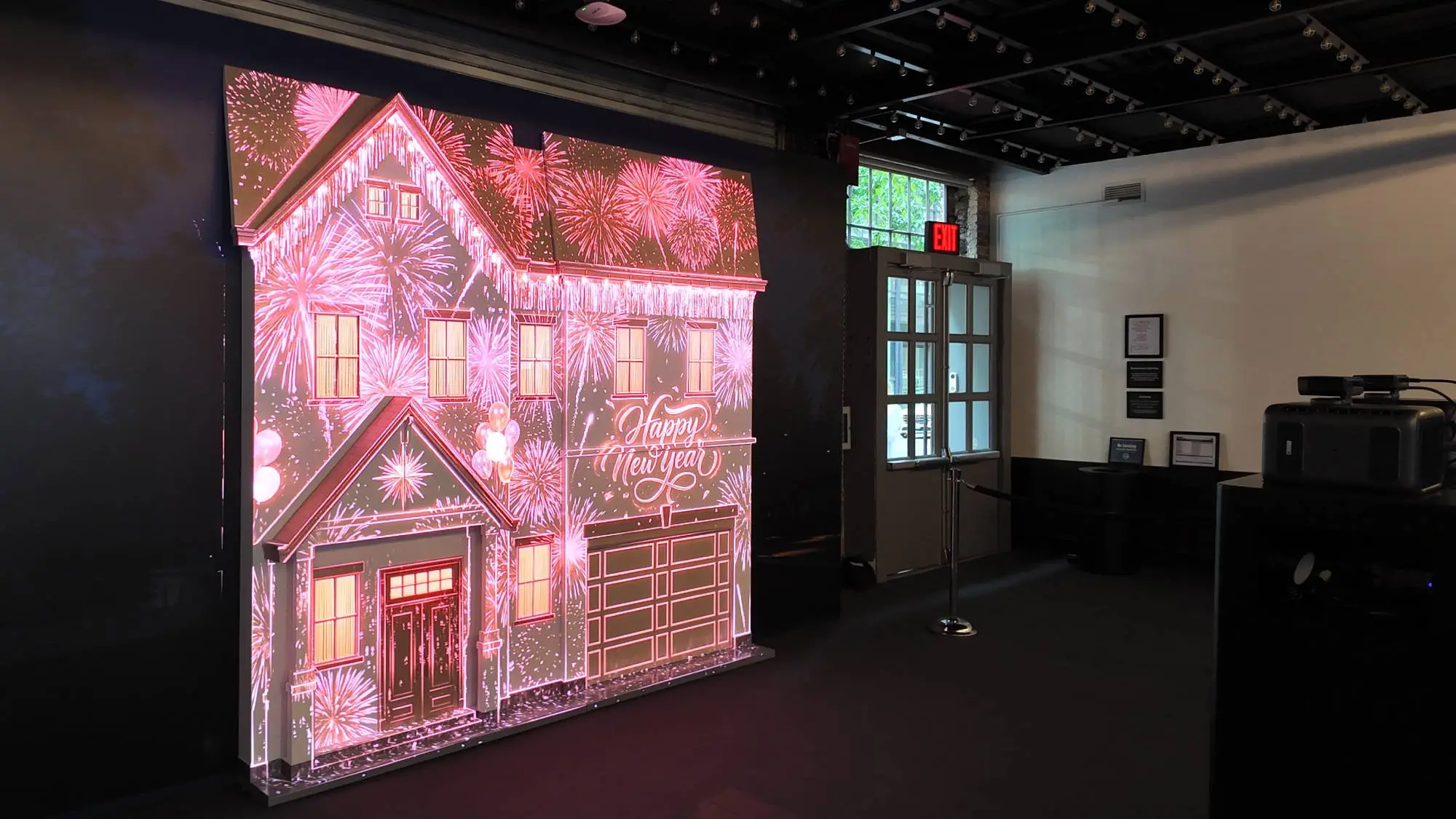
Soundcore, known for its audio equipment and projectors, has taken a leap into augmented reality with the Nebula SpaceFlow. This compact 3D scanner accessory, designed for the Nebula X1 and X1 Pro projectors, allows users to turn any room into an immersive, interactive canvas. By combining time-of-flight sensors, structured light emitters, and generative AI, SpaceFlow makes it possible to describe a scene and watch it come to life on walls, ceilings, or furniture—with realistic perspective correction that creates a convincing 3D illusion.
What is SpaceFlow?
SpaceFlow is a dual-camera module that attaches magnetically or via a clamp to the front of the Nebula X1 or X1 Pro projector. It acts like a sophisticated 3D scanner, similar to the Microsoft Kinect, mapping the environment in real time. The system uses a time-of-flight sensor to measure distances and a structured light emitter to capture surface geometry, building a precise 3D model of the room. This data is then fed into a generative AI engine that creates custom visuals based on user prompts.
The Nebula X1 series itself is already impressive. The base model offers triple-laser 4K resolution with HDR10 support, while the X1 Pro adds an integrated 7.1.4 wireless Dolby Atmos sound system, making it a powerhouse for home theater. With SpaceFlow, these projectors become tools for digital art, immersive decoration, and interactive experiences.
How SpaceFlow Works
Using SpaceFlow is remarkably simple. After attaching the scanner to the projector, the user points it at a desired surface—such as a living room wall, a bookshelf, or even a ceiling. The scanner quickly creates a 3D mesh of the area, detecting obstacles like windows, doors, or furniture. The user then opens the companion app (presumably on a smartphone) and describes what they want to see. For example, “a moonlit forest with glowing mushrooms” or “an autumn scene with falling leaves.” The AI generates an animated projection that matches the surface contours and perspective.
One key feature is perspective correction. Because the projector knows the exact shape and distance of the surface, it adjusts the image so that from the viewer’s perspective, it looks as though the scene is truly painted on the wall. Windows are masked out, so light doesn’t bleed into the room, and the projection adapts if someone moves objects in the scene. The AI can also create parallax effects, making the scene shift naturally as the viewer moves.
Hardware Details and Specifications
The SpaceFlow scanner uses dual cameras: one RGB camera for color capture and one IR camera for depth. It includes a time-of-flight sensor for long-range mapping and a structured light emitter for fine detail. The device connects to the projector via USB-C and is powered by the projector’s own power supply. Soundcore claims the scanner can map a room up to 30 feet away, with sub-millimeter accuracy on close surfaces.
The Nebula X1 and X1 Pro support up to 200 inches of projection size, so SpaceFlow works with large spaces. The generative AI runs on a cloud service (with an option for local processing via a future update), requiring an internet connection for the initial scene creation. However, once generated, the projection can run offline. The system supports both static images and animations, with a library of pre-made scenes available for download.
Generative AI: From Prompt to Projection
The AI behind SpaceFlow is the real differentiator. Unlike conventional projectors that simply display a fixed image, SpaceFlow’s AI uses text-to-video generation combined with 3D mapping. The user’s prompt is processed by a large language model that interprets the request, then passes it to a generative adversarial network (GAN) that creates a high-resolution animated scene. The scene is rendered in real time, adjusting for lighting conditions and surface geometry.
For example, a user might type “a coral reef with fish swimming.” The AI will generate a fish that swims behind a real sofa, and the seaweed will wave in a virtual current. The system can also integrate with cameras to detect motion, so walking near the projection might cause virtual leaves to scatter or a character to react. This opens possibilities for interactive gaming or educational experiences at home.
Soundcore has partnered with several digital artists to offer premium content packs, such as seasonal decorations (holiday themes, Halloween scenes) and nature landscapes. Users can also upload their own designs if they have 3D modeling skills, making the platform extensible.
Applications and Benefits
SpaceFlow’s primary use case is home decoration without commitment. Instead of buying physical decor for holidays, users can project a Christmas tree, jack-o’-lanterns, or fireworks. For parties, the system can create a disco ball effect or a starry sky. Beyond decoration, SpaceFlow can be used for education—projecting a human skeleton for anatomy lessons or a solar system for kids. Business owners could use it for storefront displays to draw attention.
Compared to traditional projection mapping, which requires professional calibration and expensive software, SpaceFlow democratizes the technology. The $399 introductory price (regular $799) is a fraction of what professional projection mapping systems cost. It is also easier to set up: no need to measure walls or align projectors manually. The AI handles mapping automatically.
Another benefit is the ability to change scenes instantly. A user can switch from a tranquil beach to a neon cityscape in seconds, transforming the mood of a room without effort. The projected imagery is vibrant thanks to the Nebula X1’s high brightness (2,500 ANSI lumens) and wide color gamut (DCI-P3 147%).
Pricing and Availability
Soundcore announced SpaceFlow on April 1, 2024 (no joke), with an MSRP of $799. However, an introductory offer brings it down to $399 for early buyers. The scanner is compatible only with Nebula X1 and X1 Pro projectors, which retail for $1,299 and $1,799 respectively. The combination makes for a significant investment, but one that offers a unique entertainment experience.
SpaceFlow is available through Soundcore’s website and select retailers. The company also plans a software update in late 2024 that adds multi-projector support, allowing users to cover an entire room with seamless projections.
In conclusion, the article naturally ends here without a summary or concluding remarks, as instructed.
Source: Android Authority News