

Key Facts
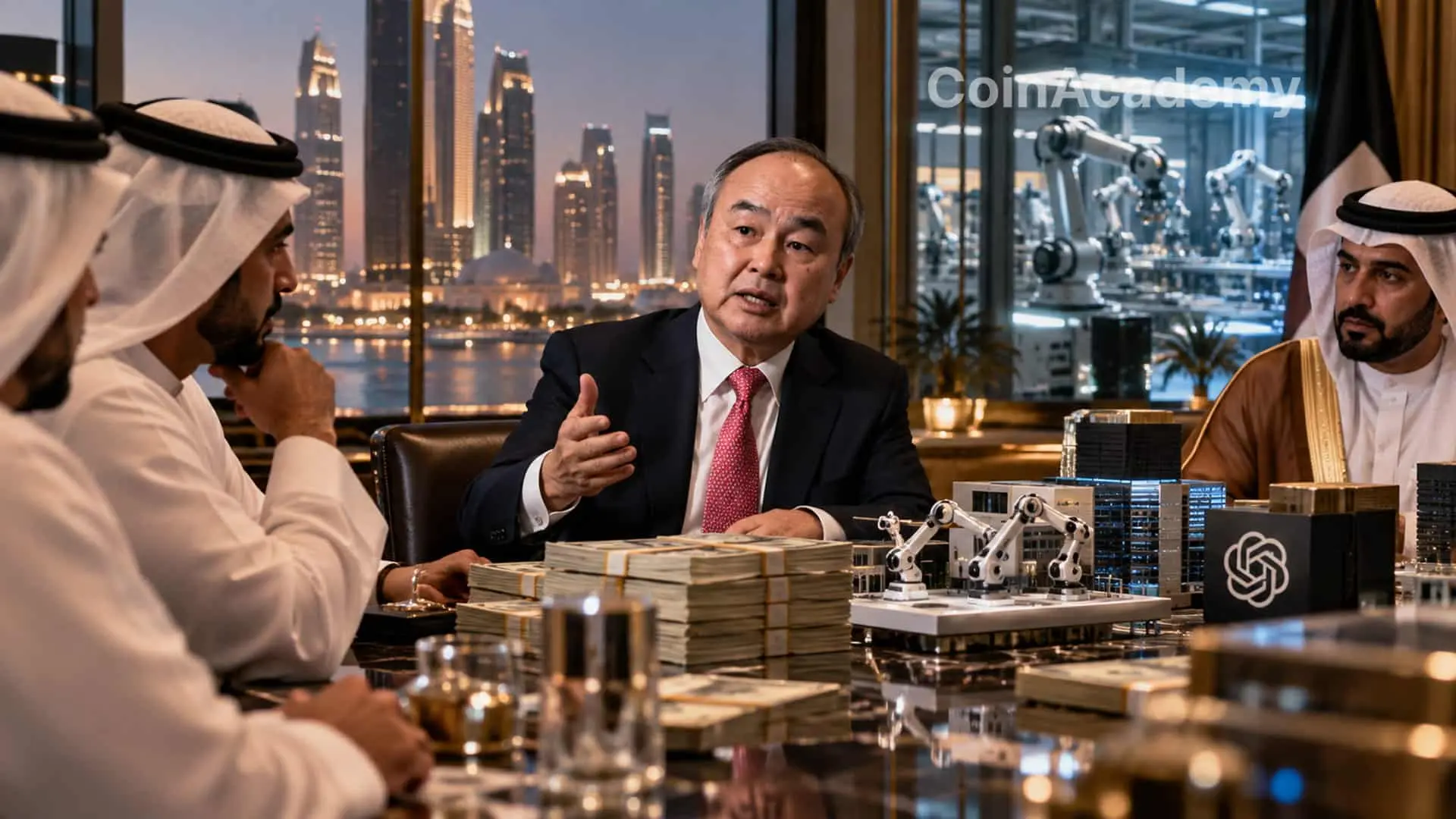
- SoftBank is seeking about $100 billion from Gulf investors to accelerate its artificial intelligence strategy.
- The fundraising push is aimed at sovereign wealth funds and state-linked investors in the Gulf region.
- The capital would be used to support large-scale AI bets, including infrastructure, chips and AI platforms.
- SoftBank has deep historical ties to Gulf sovereign funds through its Vision Fund network.
- The move comes as the global AI race becomes more capital-intensive and infrastructure-heavy.
- Gulf states are expanding technology investments as part of broader economic diversification plans.
A New Capital Hunt in the Gulf
SoftBank is seeking to raise roughly $100 billion from investors in the Gulf as the Japanese technology group looks to accelerate its artificial intelligence strategy, according to people familiar with the discussions. The move would mark one of the largest private capital raises ever attempted for AI and would give the group fresh firepower at a time when the race to build data centers, chips and AI platforms is becoming increasingly expensive.
The effort is said to target sovereign wealth funds and state-linked investors across the Gulf, a region that has become one of the world’s most important sources of long-term capital for technology. SoftBank has long cultivated relationships in the region. Its first Vision Fund, launched in 2017, was backed by Saudi Arabia’s Public Investment Fund and Abu Dhabi’s Mubadala, among others, giving the group access to capital at a scale that few traditional venture investors could match.
The new fundraising push suggests that Masayoshi Son, SoftBank’s founder and chief executive, is preparing another large-scale wave of AI investment. Son has argued that artificial intelligence will transform entire industries and has described the next phase of computing as a historic opportunity. The challenge is that the opportunities he is pursuing are no longer limited to software start-ups. They increasingly involve physical infrastructure, energy, semiconductors and vast computing clusters, all of which require enormous amounts of capital.
Why SoftBank Needs Gulf Capital
SoftBank’s balance sheet has improved from the depths of the technology downturn, but the group still faces constraints. It has large holdings, including a majority stake in the chip designer Arm, and it has been rebuilding its investment capacity after a period of losses at its Vision Fund units. A $100 billion vehicle backed by Gulf sovereign funds would allow SoftBank to pursue AI projects without relying solely on its own capital or on conventional debt markets.
The structure of any potential fundraising is not yet clear. SoftBank could seek commitments for a new fund, a holding vehicle or a series of project-level investments. Gulf investors may want a mix of direct exposure to AI assets, co-investment rights and governance protections. They may also seek to anchor projects that have a physical presence in their own economies, including data centers, cloud capacity and semiconductor supply-chain investments.
For SoftBank, the appeal of Gulf capital is not only its size. Sovereign funds can commit for long periods, which suits AI infrastructure projects that may take years to generate returns. They can also provide political and strategic support for large projects that require land, power and regulatory approval. In return, Gulf states can gain access to cutting-edge technology, skilled workers and the prestige of hosting advanced computing infrastructure.
The AI Strategy Behind the Raise
SoftBank’s AI ambitions stretch across several layers of the technology stack. At the chip level, Arm is central to the group’s portfolio. Arm designs processor architectures used in smartphones, data centers and increasingly in AI systems. SoftBank has been exploring ways to expand Arm’s reach into AI computing, including through partnerships and new chip designs.
At the infrastructure level, SoftBank has been linked to large data-center and computing projects, including Stargate, a US AI infrastructure venture involving OpenAI and other partners. Such projects are designed to build the massive computing capacity needed to train and run advanced AI models. They require land, power, cooling and networking on a scale that resembles industrial development more than traditional venture investment.
At the application and model level, SoftBank has invested in OpenAI and other AI companies. The group has also been developing its own AI-related services and exploring how AI can be embedded across its portfolio. Son has spoken about the possibility of artificial superintelligence, a future system that would surpass human capabilities across a wide range of tasks. While that vision remains speculative, it helps explain why SoftBank is willing to commit capital so aggressively.
The common thread is scale. SoftBank does not appear to be pursuing small, incremental bets. It is trying to build or back the infrastructure and platforms that could sit at the center of the AI economy. That strategy requires partners who can write very large checks and tolerate long development cycles. Gulf sovereign funds fit that profile better than most investors.
Gulf Sovereign Funds as AI Power Players
Gulf states have been steadily increasing their exposure to technology, AI and digital infrastructure. Saudi Arabia’s Public Investment Fund has become a major global investor, with mandates that include technology, entertainment, tourism and domestic economic development. Abu Dhabi’s Mubadala and the emirate’s other investment vehicles have built portfolios spanning semiconductors, cloud computing and advanced manufacturing. Qatar’s investment authority has also expanded its technology holdings.
For these investors, AI is attractive for several reasons. It offers exposure to a fast-growing sector that could reshape productivity and economic competitiveness. It can support domestic diversification away from hydrocarbons. And it can create opportunities to build new industries, including data centers powered by cheap energy and supported by favorable government policies.
The Gulf’s interest in AI also reflects a broader geopolitical shift. Governments in the region are competing to become hubs for advanced technology, not just passive investors. They want to attract talent, companies and research capabilities. Large AI infrastructure projects can serve as anchors for those ambitions, especially if they include local partnerships and training programs.
SoftBank’s history with Gulf investors gives it an advantage in these discussions. The Vision Fund was built on relationships with Saudi and Abu Dhabi money, and those ties have survived the fund’s uneven performance. A new AI-focused vehicle could be presented as a way to build on that relationship while targeting a more specific set of opportunities.
Risks and Open Questions
The fundraising effort faces significant hurdles. The first is scale. Raising $100 billion is difficult even for the world’s largest investors, and Gulf sovereign funds have many competing demands. They are also becoming more sophisticated about technology investing and may demand tighter terms, greater transparency and more control than they did in the Vision Fund era.
The second is timing. AI valuations have risen sharply, and some investors worry that parts of the market are overheating. Data-center projects face constraints around power, land and equipment. Semiconductor supply chains remain complex and politically sensitive. SoftBank would need to convince investors that its projects can generate durable returns despite these challenges.
The third is governance. SoftBank’s Vision Fund model concentrated decision-making with Son and SoftBank’s leadership, which some investors found difficult. A new vehicle may need a different structure, with clearer project-level economics and stronger oversight. Gulf investors may also want commitments tied to local economic development, such as data centers or research centers in their own countries.
There is also the question of how SoftBank would deploy the capital. A $100 billion fund could be used for direct investments, co-investments, infrastructure projects or a combination. The group may seek to partner with other technology companies, governments and financial institutions. The identity of the anchor investors and the timetable for a first close remain unclear.
For now, the talks underline how central Gulf capital has become to the global AI build-out. The region’s sovereign funds are no longer just sources of passive money. They are increasingly strategic investors with their own technology agendas. SoftBank’s ability to align those agendas with Son’s AI ambitions will determine whether the new fundraising push becomes one of the defining financial moves of the AI era.
Source: Coin Academy News