

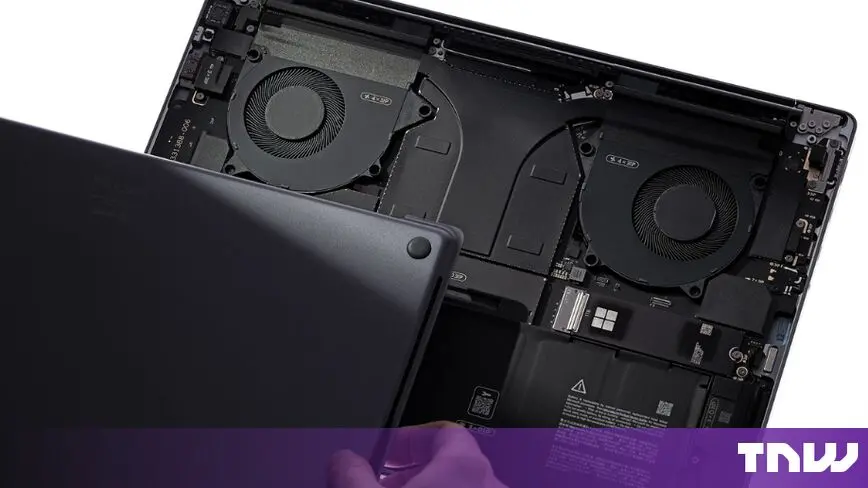
Microsoft has opened pre-orders for the Surface Laptop Ultra, its first laptop built around an Nvidia processor, at a starting price of $2,599.99. The company used its launch event in San Francisco to claim the machine returns prompts from locally run AI models twice as fast as Apple's MacBook Pro M5 and generates video six times quicker. Microsoft has not published the test methodology behind either comparison.
The Surface Laptop Ultra can be configured with up to 20 Nvidia Grace cores, up to 128GB of unified memory, and up to 2TB of storage. The only measurement Microsoft footnotes is display brightness: 2,000 nits peak, measured over a 10% window with HDR content, against laptops available in October 2026. Apple's machines receive no equivalent disclosure in the materials.
Key facts
- Microsoft's first Nvidia-powered Surface Laptop Ultra starts at $2,599.99.
- Microsoft claims it doubles a MacBook Pro M5 on local AI prompts and is six times faster at video generation.
- No test methodology has been published for either performance claim.
- Configuration options include up to 20 Nvidia Grace cores, up to 128GB unified memory, and up to 2TB storage.
- The chip is part of Nvidia's RTX Spark platform, pairing a Blackwell GPU with a Grace CPU co-designed with MediaTek.
- Nvidia claims up to one petaflop of AI compute for RTX Spark.
- Dell, HP, Lenovo, Asus, and MSI are also shipping machines built on the platform.
- Grace is built on Arm's architecture, licensed after Nvidia's $40 billion bid for Arm collapsed in February 2022.
- European laptop shipments are forecast to fall 6.4% this quarter and 20% in the fourth quarter, with desktops down almost 30%.
- Gartner does not expect AI PCs to become a majority of shipments until 2028.
A price that undercuts Apple but raises questions
At $2,599.99, the Surface Laptop Ultra undercuts a 16-inch MacBook Pro by roughly $400. That positioning matters because Microsoft is not merely selling a new flagship; it is testing whether Windows hardware can command a premium in the same conversation as Apple's professional laptops. The price also arrives against a difficult backdrop for the PC industry. A memory shortage has pushed hardware costs higher, and Nvidia raised the price of its DGX Spark by about 75% to $6,950. Analysts had flagged cost as the open question ahead of the launch, because advanced memory and AI-oriented silicon are not cheap.
Microsoft's pricing therefore does two things at once. It signals that the company believes the Nvidia brand and local AI performance can justify a high-end Windows notebook, and it tries to stay within reach of buyers who might otherwise choose a MacBook Pro. Whether that calculus works will depend on independent benchmarks, especially since the headline performance claims lack published methodology. A claim of twice the speed on local AI prompts and six times faster video generation is bold, but without details about model size, quantization, prompt type, power settings, thermal conditions, or software stack, it is difficult to verify.
The chip: RTX Spark and the Arm connection
The more consequential part of the announcement is the silicon. The Surface Laptop Ultra uses Nvidia's RTX Spark platform, which pairs a Blackwell graphics processor with Nvidia's Grace CPU. The Grace CPU was co-designed with MediaTek and is built on Arm's architecture. Nvidia says RTX Spark can deliver up to one petaflop of AI compute, a figure that would have been unthinkable in a laptop not long ago. Dell, HP, Lenovo, Asus, and MSI are also shipping machines built on the platform, meaning Nvidia is not entering the laptop market alone. It is arriving with a broad ecosystem of PC makers behind it.
That puts Nvidia into a market Intel and AMD have shared for decades. But Nvidia is doing so on someone else's instruction set. Grace is built on Arm's architecture, licensed from the Cambridge company Nvidia agreed to buy for $40 billion. The acquisition collapsed after regulators objected, and SoftBank confirmed the deal was dead in February 2022. As a result, every RTX Spark laptop pays Arm a royalty. The arrangement is a reminder that the AI PC boom is not just a competition between chip designers and system builders; it also reshapes licensing, supply chains, and the balance of power in processor architecture.
Arm's role is particularly notable because Apple also builds its Mac processors on Arm architecture. Microsoft's comparison to the MacBook Pro M5 therefore pits two Arm-based ecosystems against each other, but with very different software and hardware integration. Apple controls the silicon, operating system, and developer tools. Microsoft must coordinate with Nvidia, MediaTek, Arm, and a wide range of PC manufacturers. That complexity can produce flexibility and competition, but it can also make it harder to deliver the kind of tightly optimized experience Apple markets.
Local AI versus the cloud
Microsoft's pitch extends beyond raw performance. Executives argued that running AI on the machine in front of you is cheaper and more secure than paying a cloud provider. That argument has become central to the AI PC category. Local inference can reduce latency, keep sensitive data on-device, and avoid recurring cloud costs. For some workflows, especially those involving confidential documents, local processing may be attractive. But local AI also has limits: laptop memory, battery life, and thermal constraints can restrict model size and sustained performance. Cloud providers can offer larger models and easier scaling.
The security and cost argument is not purely theoretical. The Dutch tax office reached a similar conclusion about its email this week and is moving it off Microsoft's cloud onto its own servers. That decision does not directly involve the Surface Laptop Ultra, but it illustrates the broader tension. Organizations are weighing the convenience of cloud services against control, compliance, and long-term expense. Microsoft is simultaneously one of the largest cloud providers and a vendor selling local AI hardware, so its pitch must navigate that conflict.
A difficult market for premium PCs
The launch comes as the PC market faces renewed pressure. European laptop shipments are forecast to fall 6.4% this quarter and 20% in the fourth quarter, with desktops down almost 30%, according to Gartner. Memory costs are raising system prices, and companies are stretching their refresh cycles. Gartner also does not expect AI PCs to be a majority of shipments until 2028. That timeline suggests the AI PC transition will be gradual, even if vendors are eager to promote it now.
For Microsoft, the Surface Laptop Ultra is both a product and a statement. It shows that Windows hardware can adopt Nvidia's AI-focused platform, that Arm-based computing continues to expand, and that Microsoft wants a flagship capable of competing with Apple on performance and price. But the claims require scrutiny. The absence of published test methodology for the AI comparisons leaves room for doubt, and the market conditions are not favorable for expensive upgrades. The device may appeal to developers, creators, and professionals who need local AI compute, but it will face questions about battery life, software compatibility, and real-world speed.
The most interesting tension is architectural. Nvidia's failed Arm acquisition was once seen as a setback. Now Nvidia is shipping an Arm-based CPU in laptops, paying royalties to Arm, and challenging Intel and AMD in a market they long dominated. Microsoft, meanwhile, is trying to sell local AI as a safer and cheaper alternative to the cloud, even as its own cloud business remains central to its future. Those contradictions will shape how the Surface Laptop Ultra is received. The laptop's price, specifications, and performance claims are now public. The missing piece is independent evidence.