

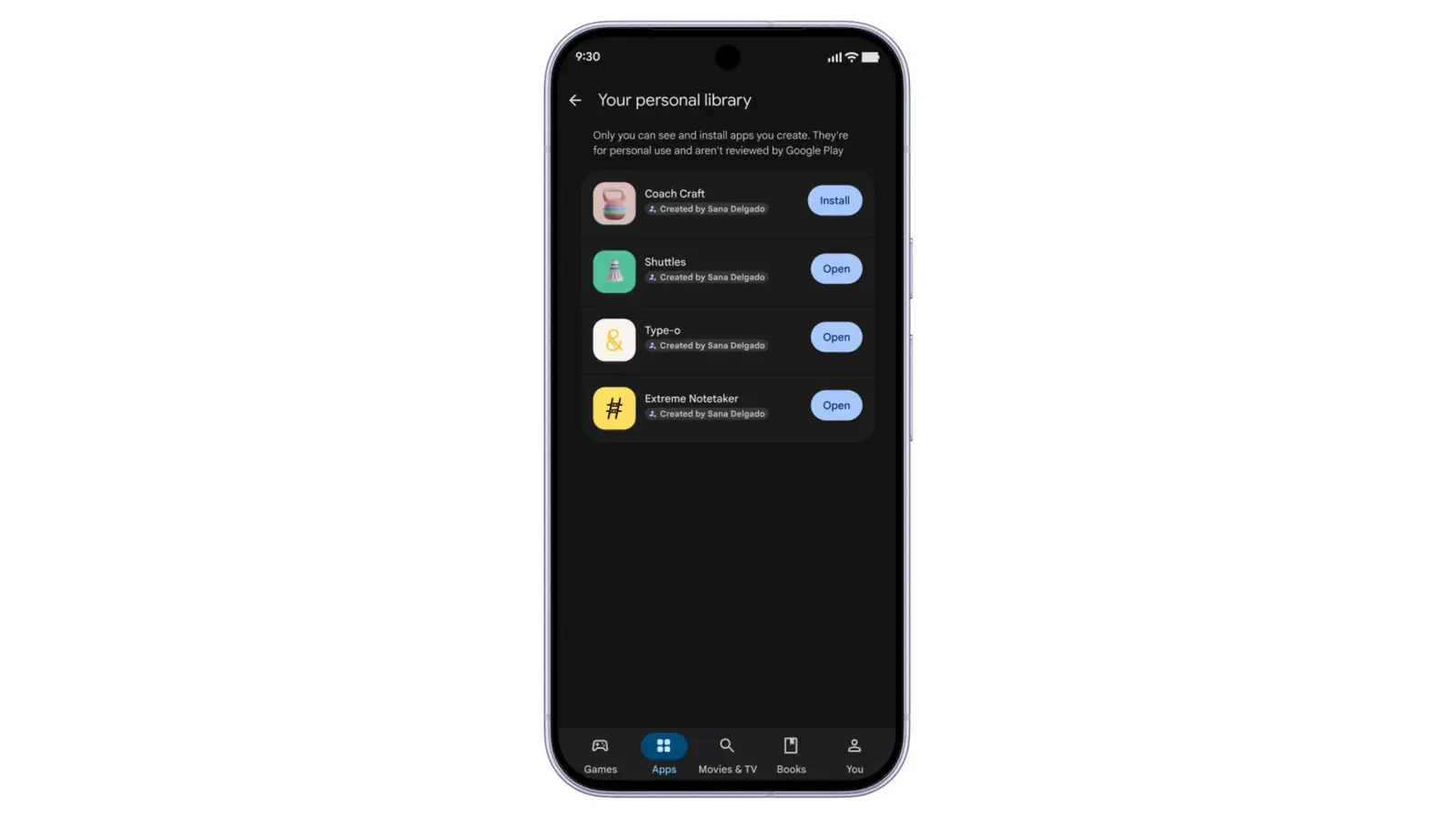
Google is preparing to let people who create Android apps with AI assistance publish those apps through the Play Store using only a Google account, removing the requirement for a paid developer account in the first stage of a broader Play Store overhaul. The change applies to apps built in Google AI Studio, where users can generate an app from a written prompt to Gemini and refine the result with more prompts or by editing the generated code directly. The rollout is set to reach users in the United States and other select markets who are 18 and older.
At launch, those apps will not appear in the public store. They will live in a new personal library section and be available only on the creator’s own devices, including tablets and computers that can access the Play Store. Google says it plans to add secure sharing with friends and family later. If a creator wants a global audience, they will be able to graduate to a professional developer account and submit the app to the Play Store’s normal safety reviews.
Key facts at a glance
- Google will allow vibe-coded Android apps from AI Studio to be distributed through the Play Store with just a Google account.
- The initial rollout covers users 18 and older in the US and select markets.
- Apps start in a personal library limited to the creator’s own devices.
- Sharing with friends and family is planned, while public distribution will require a professional developer account and safety review.
- Google is also adding AI-assisted discovery, sports pages, Game Finder, game playlists and new developer engagement tools.
Publishing without a paid developer account
The publishing change is notable because it lowers a barrier that has long separated casual experimenters from official app distribution. Android has always allowed users to install apps from outside the Play Store through APK sideloading, but that process has become more complicated in recent years. Google’s new approach offers a more managed path for AI-generated apps while keeping the first release private to the creator. It also creates a bridge between experimentation and formal publishing. A person can start with a prompt, test an app on their own phone or tablet, and decide later whether to pursue a professional developer account.
That bridge matters for the growing group of people who use AI tools to make software without traditional programming training. Vibe coding, as the practice is often called, prioritizes natural-language instructions and rapid iteration over hand-written code. In AI Studio, a user can describe an idea to Gemini and receive a working app that can then be adjusted through further prompts or manual edits. The result may be simple, personal or experimental, but the workflow is far faster than starting from an empty codebase.
Why the change matters
Google’s Play Store has changed significantly in recent years as the company has pushed AI into its products and responded to legal and competitive pressure to open the store to rivals. The new publishing option could be one of the most consequential updates because it touches who can distribute software and how apps enter the Android ecosystem. Instead of treating official distribution as a step reserved for professional developers, Google is testing a model where a Google account is enough to place a personal app on a user’s own devices through the store.
The limited personal library also gives Google a way to separate personal experimentation from public release. Apps are not immediately exposed to the full Play Store audience, and they do not go through the same public safety review until a creator chooses to graduate. That structure may reduce risk while giving creators a simpler testing ground. It also raises questions about how Google will handle security, privacy and quality as more AI-generated apps move through the system.
From personal library to public release
The personal library is designed for apps that are useful to their creator first. A user might build a small utility for personal workflows, a simple game, a tracker or a niche tool. Because the apps are available only on the creator’s own devices, the audience is limited and the stakes are lower. Google has said it eventually wants to let creators share apps securely with friends and family, which would expand the audience without making the app publicly available to everyone.
Public distribution remains tied to the professional developer account and the Play Store’s normal safety reviews. That distinction is important. It means the new process does not eliminate Google’s review system for apps intended for a global audience. Instead, it creates a staged path: create with AI, test privately, share with a small group, and then move to a formal developer account when the app is ready for wider release. For Google, that path could encourage more people to move from experimentation to official publishing over time.
AI Studio and the rise of vibe coding
Google AI Studio is central to the change. The tool can generate apps from written prompts to Gemini, and users can refine results with additional prompts or by editing the generated code themselves. That flexibility is part of what makes vibe coding appealing: it does not require a user to choose between pure no-code generation and full manual development. A creator can start with a prompt, ask for changes, and then inspect or adjust the code when necessary.
The rise of vibe coding has already changed expectations around software creation. People who are not professional engineers can prototype ideas quickly, while experienced developers can use AI to speed up repetitive work. But AI-generated apps can also carry hidden problems, from insecure data handling to fragile code and unclear ownership of assets. Google’s staged approach appears designed to let people experiment privately before exposing an app to public review and a wider audience.
Play Store discovery gets more AI and more context
Publishing is only one part of the Play Store update. Google is also adjusting how people find apps and games. The company previously introduced Ask Play at I/O 2026, and it is now bringing similar discovery features to Gemini by letting the AI assistant surface direct links to Play Store apps in chats. That could make app recommendations feel more conversational, with users asking for a type of app and receiving relevant store links without leaving the assistant.
Google is also expanding sports topic pages in the Play Store during live matches. Those pages will cover soccer games from the Premier League, Major League Soccer and more. The idea is to connect app discovery to real-time events, so users can find relevant apps while a match is underway. In cars with Google built-in and on Android XR, Google is updating the Play Store layout to better fit the size of the physical or virtual screen. That change reflects the growing range of devices where Android apps and services are accessed.
Gaming features target taste, competition and community
For people looking for games, Google is introducing a Game Finder feature that recommends titles based on individual taste. The recommendations are built on Gamer DNA, a new taste profile that users can fine-tune with their preferences and favorite genres. During a press roundtable, Google suggested it hopes to make filters and genre tags increasingly granular, potentially allowing users to drill down into attributes such as controller support. A new game playlists feature will also let people recommend collections of mobile games for others to try.
Google is updating the playing experience as well. The Sidekick overlay is gaining a feature that can record 30-second clips of gameplay. Developers are also receiving new tools intended to increase engagement, including Sprints, Community Posts and an expansion of Quests. Sprints are 48-hour in-game challenges that match players of similar skill levels to compete for the highest score. Quests previously let developers reward players with Play Points and now also allow in-game rewards. Community Posts adds a Q&A section to store pages so players can ask and answer questions about games directly in the Play Store.
What the shift could mean for the app ecosystem
The success of these features will depend heavily on how much users trust AI to build apps and recommend content. AI-generated apps can be useful and highly personal, but they can also be unpredictable, especially when they handle data or interact with other services. Google’s decision to keep the first version of the publishing program limited to personal devices suggests the company is aware of those risks. The ability to graduate to a professional account and undergo normal safety reviews gives creators a clear route to public distribution without opening the entire store to unreviewed software.
The changes also signal that Google is trying to stay competitive as third-party app stores become installable through the Play Store. By making it easier for individuals to create and distribute Android apps, Google can encourage more experimentation inside its ecosystem. At the same time, the company is adding AI-assisted discovery and more contextual recommendations, which could help it hold attention as users search for apps through Gemini, sports pages and gaming features.
For creators, the practical effect is a lower entry point and a staged path to publication. For users, the effect may be a larger supply of small, personal apps, more conversational recommendations and games organized around individual taste. The program’s rollout will begin with adults in the US and select markets, and its expansion will depend on how Google handles sharing, safety and the transition from private experimentation to public release.
Source: Engadget News